Play England responds to Government consultations on national planning policy and guidance
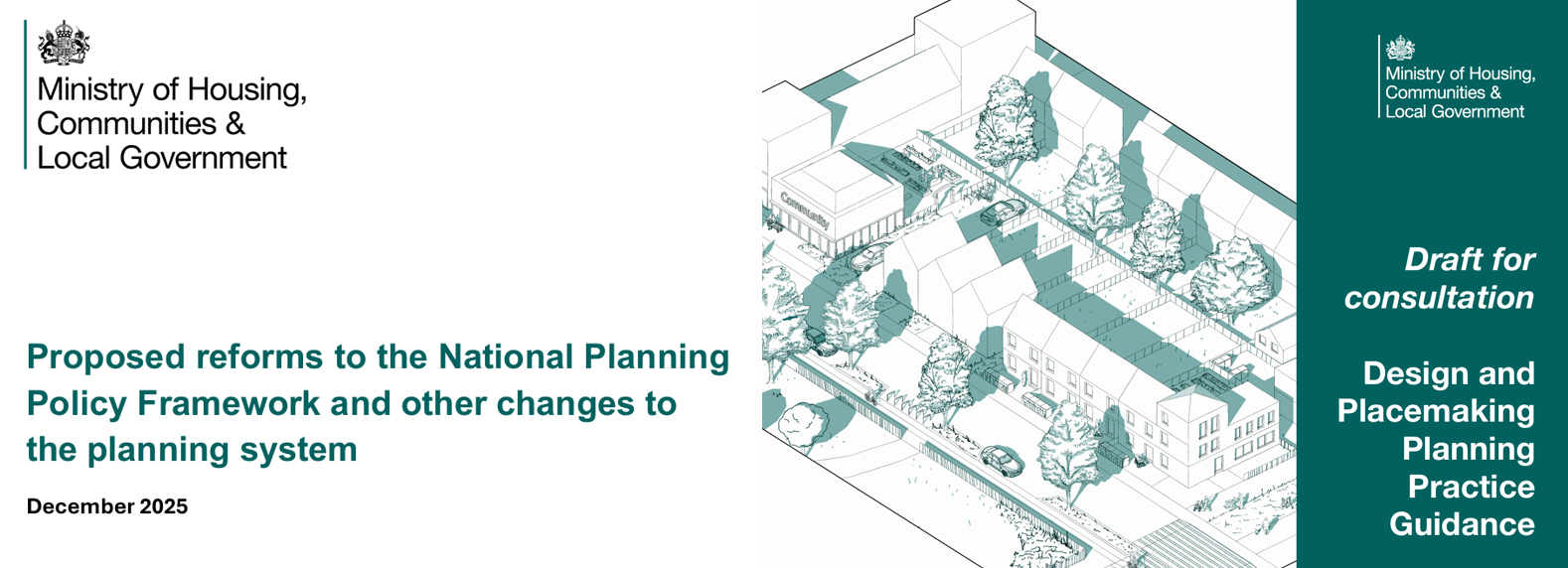
The consultations follow Play England’s advocacy in Parliament on play sufficiency and commitments from Ministers to strengthen national planning policy and guidance
Play England has submitted a formal response to the Government’s consultation on proposed reforms to the National Planning Policy Framework (NPPF) and the Design and Placemaking Planning Practice Guidance (DPPPG).
These consultations represent an important opportunity to strengthen the role of the planning system in ensuring children have safe, accessible and inclusive opportunities to play within their everyday neighbourhoods.
They also mark the next step in sustained work led by Play England to ensure children’s play is properly recognised within national planning policy and guidance.
The consultations follow both the strengthening of protections for formal play spaces in the NPPF in December 2024 and commitments made by the Minister during the passage of the Planning and Infrastructure Act in 2025 to consider further changes to national planning policy and guidance on play.
Building on the 2024 NPPF change
The consultations also build on an earlier policy change secured through Play England’s advocacy.
In December 2024 the Government amended the NPPF to explicitly recognise the need to protect ‘formal play spaces’ within national planning policy for the first time. That change positioned children’s play alongside other forms of social infrastructure that the planning system must safeguard.
The current consultations now create an opportunity to go further by embedding play more fully within both national policy and planning guidance.
From Parliament to planning policy reform
In June 2025, during the passage of the Planning and Infrastructure Act, Play England worked with Tom Hayes MP to introduce NC82 – the Play Sufficiency amendment. The amendment sought to place a duty on planning authorities to assess and secure sufficient opportunities for children’s play.
The amendment attracted support from 71 MPs across the House. While the Government ultimately chose not to legislate at that time, Ministers acknowledged the importance of the issue and committed to strengthening national planning policy.
Responding to the amendment during the debate, the Minister acknowledged the importance of children’s play and confirmed that the Government would consider strengthening national planning policy:
“Turning to the important issue of children’s play areas and playing fields, I thank the hon. Member for Taunton and Wellington for tabling new clause 16 and my hon. Friend the Member for Bournemouth East (Tom Hayes) for tabling new clauses 82. I particularly commend my hon. Friend on all that he is doing to make the case for high-quality, accessible and inclusive areas for play. The Government agree that access to play space is vital, which is why strong protections are already in place.
The national planning policy framework is clear that local planning policies should be based on robust and up-to-date assessments of the need for open space, sport and recreation facilities, and opportunities for new provision, including places for children’s play. In December (2024), we strengthened the strong protections already in place in the NPPF by adding explicit reference to safeguarding “formal play spaces”. That means that those facilities can be lost only where they are no longer needed, or where there is a justified and appropriate alternative.
Given the existing policy expectations, safeguards and sources of support, we do not believe that it is necessary to add the sort of legislative requirements the amendments would entail. However, I recognise the importance of what the amendments seek to achieve, and the provision of play space is one of the areas we are considering as we prepare a new set of national planning policies for decision making, on which we will consult this year. I commit to my hon. Friend the Member for Bournemouth East to writing to my counterparts at the Department for Education and at the Department for Culture, Media and Sport to ensure that we are acting across Government to increase spaces for play. I will work with him to broker the necessary ministerial meetings that he seeks. With those assurances, I hope that he and the hon. Member for Taunton and Wellington will feel able to withdraw their amendments.”
— Matthew Pennycook MP, Minister for Housing and Planning, House of Commons debate on the Planning and Infrastructure Bill, 9 June 2025
These consultations are the direct result of that commitment to strengthen national planning policy on children’s play.
What Play England is recommending
Play England’s consultation response sets out the changes required to ensure the proposed reforms deliver meaningful improvements in children’s access to play. These include:
Clear definitions of play space
National planning policy should clearly define what constitutes play space so that meaningful provision cannot be replaced with minimal or incidental spaces.A play sufficiency approach to planning
Planning authorities should assess whether children have sufficient opportunities to play across their neighbourhoods, considering quantity, quality, accessibility, inclusivity and integration.Accessibility-based standards for play
Planning policy should move beyond outdated acreage-based standards and instead adopt accessibility measures based on walking distance.Stronger protection for existing play spaces
The Government should maintain the strong protections for formal play spaces introduced into the NPPF in 2024.Use of spatial evidence to assess provision
Planning decisions should be supported by robust spatial analysis to identify where play provision is insufficient and where inequalities exist.
National evidence informing planning policy
Play England’s consultation response highlights the need for stronger national evidence to support planning decisions about children’s play.
Understanding where play spaces are located, how accessible they are, and how provision varies across communities is essential if planning policy is to address the significant inequalities that exist in children’s access to play.
To support this, Play England has been working in partnership with the University of Sheffield to develop Playces, a national spatial evidence platform for children’s play. The underlying dataset maps almost 34,000 playgrounds across England, analysing:
playground count
playground size
distance to provision
relationship to deprivation
The analysis demonstrates that children living in more deprived areas often have access to fewer, smaller and more distant play spaces, highlighting significant inequalities in access to play across England.
Playces has been developed to support evidence-led planning for children’s play, enabling local authorities to assess play provision through a play sufficiency approach. By bringing together national spatial data and analytical tools, the platform will help identify gaps in provision and support monitoring of improvements in play opportunities over time as local plans and new development are delivered.
This kind of national spatial evidence will be increasingly important as planning authorities move toward assessing play sufficiency within local plans and development decisions.
Planning plays a critical role in children’s lives
Street layouts, housing density, green infrastructure and neighbourhood connectivity all shape whether children can play safely and independently in their everyday neighbourhoods.
Children’s play is recognised as a fundamental right under Article 31 of the UN Convention on the Rights of the Child, further elaborated through General Comment 17, which emphasises the responsibility of governments to ensure children have sufficient time, space and opportunity to play.
Play England’s ten-year strategy - It All Starts with Play! calls for the restoration of a play-based childhood through the principle of play sufficiency.
A critical opportunity for national policy
The Government’s consultations represent a critical opportunity to strengthen national planning policy so that it better supports children’s everyday opportunities to play. With clearer policy, better spatial evidence and stronger protection for play spaces, the planning system can play a central role in restoring children’s access to play across England.
Play England will continue working with Government, Parliament and the built environment sector to ensure that children’s right to play is fully recognised within the planning system and embedded in the places where children live.
These consultations mark an important step in that work and an opportunity to ensure that national planning policy better supports children’s everyday opportunities to play.
Play England’s full consultation response can be read here.
Our response has been developed in partnership with the University of Sheffield. The analysis and recommendations set out here are also consistent with the findings of the Raising the Nation Play Commission, convened by the Centre for Young Lives, which identified the planning system as a critical factor in shaping children’s opportunities to play.
#ItAllStartsWithPlay!